In Critique of Repair: A Localised Case Study of irrepairable damage by "Cleanfill Tipping" in Melbourne's Green Wedge and Reflections for Practice
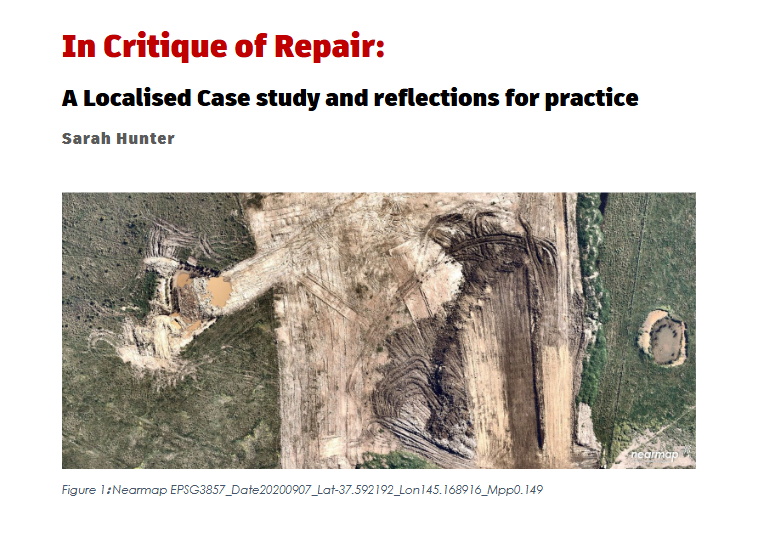
In Critique of Repair: A Localised Case study and Reflections for Practice
This piece was first written in response to a provocation on the on notion of repair. “Repair’ was, it was suggested, a nuanced approach to architectural design in the 21st century”, a positive response to an observation that ‘our capitalist economy presents a commercial incentive to raze and abandon,’
Taking a landscape and environmental perspective, I suggest that “repair” should not be seen as a benign salve to the ills of damage. Although ‘Repair’ can play a legitimate and crucial role in the face of degradation of the built and natural environment, the act of repair, with synonyms of “patch up”, “mend” and “get working again”[i] should be a response (only) to historical ills or unforeseen disaster. Too often in contemporary projects a program which includes damage to the built or natural environment is proposed with ‘repair’, ‘restoration’, or ‘mitigation’ of on- or off- site impacts an acknowledged, but incompletely conceived (or completely unconceived), stage of the process of development.
In many cases, built environment professionals are expected to mitigate problems created by their lack of involvement at the early stages of design. A notional ‘repair’ stage not be allowed to reduce the requirement to achieve good design outcome at the outset. A lighter, more conscious approach to design is appropriate to achieve sustainability, quality and distinctive design.
This piece takes a personal, place based case study of commercial “clean fill” tipping impacting my farm in the shire of Nillumbik, in Melbourne’s Green wedge. In addition to exploring the painful story of attempting to stop the tipping, I look at the source of the fill, most likely the greenfields housing development sites in Melbourne's burgeoning growth areas to the north of the CBD, and consider how better design solutions with the early involvement of built environment professionals could result in a better outcome altogether.
Framing Sustainability:
The Composting Toilet & Reduce Reuse Recycle Wet Room Facility
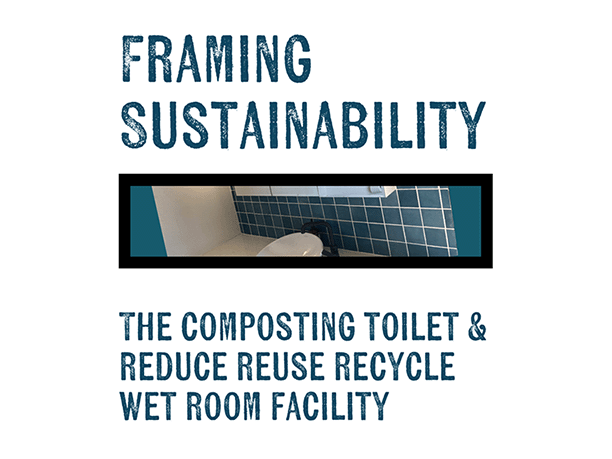
This open access article is a deep dive on my applied design philosophy around the need to integrate aesthetics into the implementation of sustainable design. It is based on the specific example of an implemented 'reduce reuse recycle' wet room including composting toilet on my farm.
The piece is illustrated and broken into main body sections as follows:
Framing in 3D & 2D
Design Philosophy
The composting toilet: Specifying the vessel for a process
Framing reuse: The reduce reuse recycle wet room
Framing a conceptual view (the need for interpretation)
Welcome to the Eco Toilet: Interpretation in 2 Dimensions
More coming soon
(or visit my 'Figshare')